
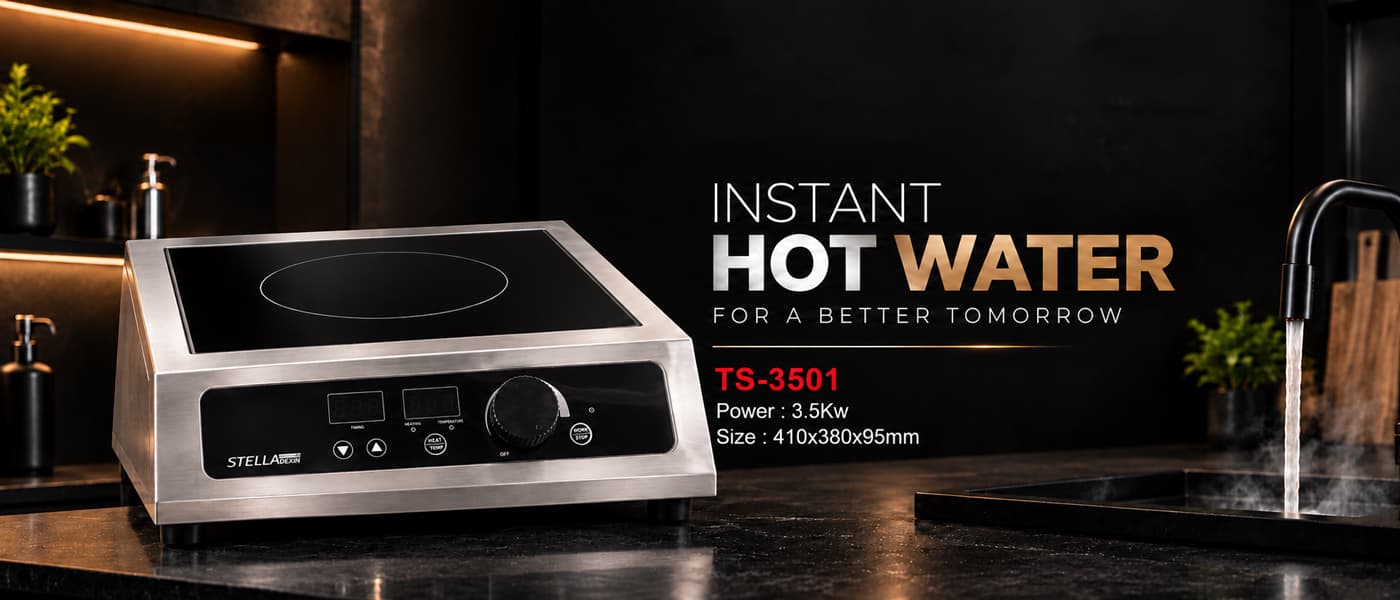
Porquê indução
Indução ou gás: a arte moderna de cozinhar.
A indução aquece o recipiente quase instantaneamente, em vez de depender da condução térmica de um queimador. O resultado: fervura mais rápida, temperatura mais estável e muito menos energia desperdiçada.
Três coisas acontecem ao mesmo tempo.
Uma bobina, não uma chama
Sob a superfície de vidro encontra-se uma bobina de fio de cobre. A passagem de corrente gera um campo magnético que alterna rapidamente.
O recipiente torna-se a resistência
Esse campo induz uma corrente na base de qualquer recipiente ferroso colocado em cima, e o próprio recipiente passa a ser a fonte de calor.
Mais nada aquece
Como o calor é gerado dentro do recipiente, muito pouco escapa para o ar em redor — a superfície mantém-se comparativamente fria.
Face ao gás e à eletricidade convencional.
Comparação geral para uma posição de cozedura profissional. Os valores reais variam com o material, a carga e a alimentação.
| Critério | Gás / elétrico | Indução |
|---|---|---|
| Tempo até ferver | Referência | Até 50 % mais rápido |
| Transferência de calor | Condução térmica | Indução magnética direta |
| Energia perdida para o ar | Significativa | Mínima |
| Resposta ao controlo | Com atraso | Quase instantânea |
| Limpeza | Grelhas e queimadores | Uma superfície de vidro selada |
Veja a gama que tira partido disso.
Ver produtosPerguntas frequentes.
Is induction actually cheaper to run than gas?
Induction puts the heat into the pan itself instead of heating the air around it, so very little energy is lost to the kitchen. It also boils water up to 50% faster than gas or conventional electric, which shortens the time a burner is drawing power at all.
Will induction work with the pans we already have?
Only with pans that have a magnetic base. The test takes a second: if a magnet sticks firmly to the underside, the pan will work. Cast iron and magnetic stainless steel are fine; aluminium, copper, glass and clay are not.
Is induction safer on a busy line?
There is no flame and no exposed element. The heat is generated inside the cookware, so the glass top stays comparatively cool and the surrounding air does not get loaded with waste heat — which makes a noticeable difference to working conditions over a long service.
Does induction need special electrical work?
It depends on the rating. Most table-top and buffet units run on a standard 220~240V single-phase supply. The 8 kW and 12 kW floor-standing ranges need a 440V three-phase supply, so the connection should be planned with an electrician before installation.
How is induction cleaned compared with gas?
There are no grates or burner heads to lift out — the top is a single sealed glass surface, so it wipes down flat at the end of service.