
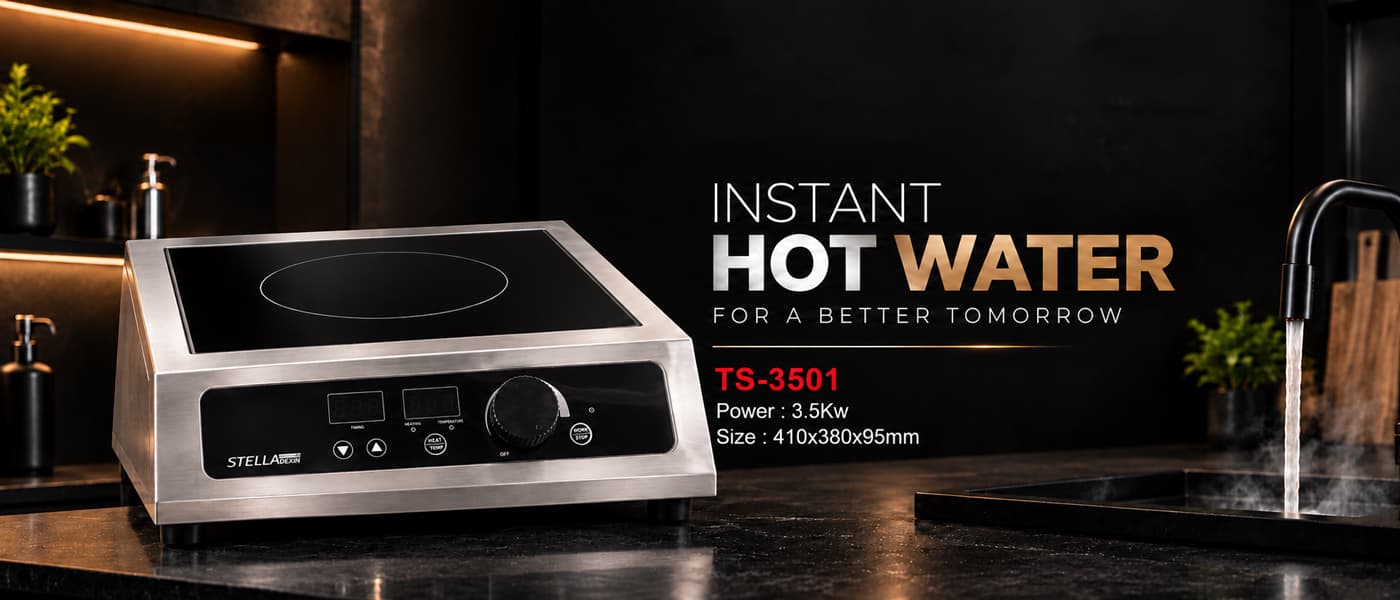
Pourquoi l'induction
Induction ou gaz : l'art moderne de la cuisine.
L'induction chauffe le récipient presque instantanément au lieu de dépendre de la conduction thermique d'un brûleur. Résultat : une ébullition plus rapide, une température plus stable et bien moins d'énergie gaspillée.
Trois choses se produisent à la fois.
Une bobine, pas une flamme
Une bobine de fil de cuivre se trouve sous la surface vitrée. Le courant qui la traverse génère un champ magnétique alternant rapidement.
Le récipient devient l'élément chauffant
Ce champ induit un courant dans le fond de tout récipient ferreux posé dessus, et le récipient devient lui-même la source de chaleur.
Rien d'autre ne chauffe
Comme la chaleur est générée à l'intérieur du récipient, très peu s'échappe dans l'air ambiant — la surface reste relativement froide.
Face au gaz et à l'électrique classique.
Comparaison générale pour un poste de cuisson professionnel. Les valeurs réelles varient selon les récipients, la charge et l'alimentation.
| Critère | Gaz / électrique | Induction |
|---|---|---|
| Temps d'ébullition | Référence | Jusqu'à 50 % plus rapide |
| Transfert de chaleur | Conduction thermique | Induction magnétique directe |
| Énergie perdue dans l'air | Importante | Minime |
| Réactivité aux réglages | Différée | Quasi instantanée |
| Nettoyage | Grilles et brûleurs | Surface vitrée scellée unique |
Découvrez la gamme qui en profite.
Parcourir les produitsQuestions fréquentes.
Is induction actually cheaper to run than gas?
Induction puts the heat into the pan itself instead of heating the air around it, so very little energy is lost to the kitchen. It also boils water up to 50% faster than gas or conventional electric, which shortens the time a burner is drawing power at all.
Will induction work with the pans we already have?
Only with pans that have a magnetic base. The test takes a second: if a magnet sticks firmly to the underside, the pan will work. Cast iron and magnetic stainless steel are fine; aluminium, copper, glass and clay are not.
Is induction safer on a busy line?
There is no flame and no exposed element. The heat is generated inside the cookware, so the glass top stays comparatively cool and the surrounding air does not get loaded with waste heat — which makes a noticeable difference to working conditions over a long service.
Does induction need special electrical work?
It depends on the rating. Most table-top and buffet units run on a standard 220~240V single-phase supply. The 8 kW and 12 kW floor-standing ranges need a 440V three-phase supply, so the connection should be planned with an electrician before installation.
How is induction cleaned compared with gas?
There are no grates or burner heads to lift out — the top is a single sealed glass surface, so it wipes down flat at the end of service.