
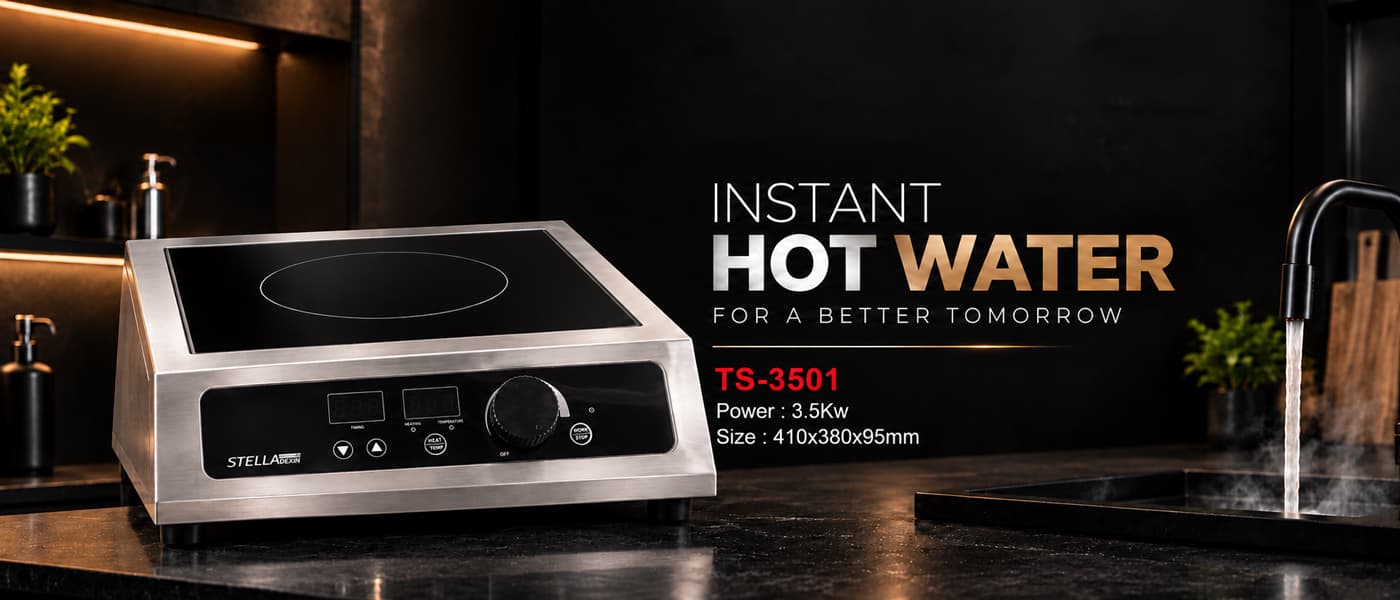
Por qué inducción
Inducción o gas: el arte moderno de cocinar.
La inducción calienta el recipiente casi al instante en lugar de depender de la conducción térmica de un quemador. El resultado: hervido más rápido, temperatura más estable y mucha menos energía desperdiciada.
Tres cosas ocurren a la vez.
Una bobina, no una llama
Bajo la superficie de vidrio hay una bobina de hilo de cobre. Al pasar corriente por ella se genera un campo magnético que alterna rápidamente.
El recipiente se convierte en la resistencia
Ese campo induce una corriente en la base de cualquier recipiente ferroso colocado encima, y el propio recipiente pasa a ser la fuente de calor.
Nada más se calienta
Como el calor se genera dentro del recipiente, muy poco escapa al aire circundante: la superficie permanece relativamente fría.
Frente al gas y a la electricidad convencional.
Comparación general para una partida de cocción profesional. Los valores reales varían según el menaje, la carga y el suministro.
| Criterio | Gas / eléctrico | Inducción |
|---|---|---|
| Tiempo hasta hervir | Referencia | Hasta un 50 % más rápido |
| Transferencia de calor | Conducción térmica | Inducción magnética directa |
| Energía perdida al aire | Considerable | Mínima |
| Respuesta al control | Con retardo | Casi instantánea |
| Limpieza | Parrillas y quemadores | Una sola superficie de vidrio sellada |
Vea la gama que lo aprovecha.
Ver productosPreguntas frecuentes.
Is induction actually cheaper to run than gas?
Induction puts the heat into the pan itself instead of heating the air around it, so very little energy is lost to the kitchen. It also boils water up to 50% faster than gas or conventional electric, which shortens the time a burner is drawing power at all.
Will induction work with the pans we already have?
Only with pans that have a magnetic base. The test takes a second: if a magnet sticks firmly to the underside, the pan will work. Cast iron and magnetic stainless steel are fine; aluminium, copper, glass and clay are not.
Is induction safer on a busy line?
There is no flame and no exposed element. The heat is generated inside the cookware, so the glass top stays comparatively cool and the surrounding air does not get loaded with waste heat — which makes a noticeable difference to working conditions over a long service.
Does induction need special electrical work?
It depends on the rating. Most table-top and buffet units run on a standard 220~240V single-phase supply. The 8 kW and 12 kW floor-standing ranges need a 440V three-phase supply, so the connection should be planned with an electrician before installation.
How is induction cleaned compared with gas?
There are no grates or burner heads to lift out — the top is a single sealed glass surface, so it wipes down flat at the end of service.